How an Artist Can Donate Their Art to a Museum
Museums rely on artists to create compelling exhibitions, public programming, and sometimes even promotional materials. But during this unprecedented yr, they've been leaning on them more than than ever for something else, too: fundraising.
As many donors pull back from giving or feel institutions' needs dwarf what they can offer, museums have upped the dues with an irresistible depict: the opportunity to buy fine art that collectors might not otherwise accept access to. Every bit the demand for funding grows greater and hits institutions of all sizes, artists are increasingly offer up their work—and their fourth dimension—to help the cause.
"Institutions are nether a tremendous amount of stress right now," the artist Rashid Johnson tells Artnet News. "Particularly in the US where there isn't a lot of government assistance for cultural institutions, they have get incredibly dependent on patronage, and artists accept been some of the most constructive fundraising tools."
While institutions have always depended on artists to help attract donors—since feeling embedded in an artistic milieu is part of what draws philanthropists to the sector in the first place—demand seems to have increased in line with a growing demand. "I'm being asked to donate as much as I e'er have, if not a lilliputian bit more," says Johnson, whose name crops up again and once again in catalogues for charitable fundraisers.
He is far from the just one stepping upward to the plate. Artists of all stripes are designing face masks to crowdfund for the Contemporary Art Social club, producing limited-edition prints in the name of the New York University of Art, and altruistic expensive original works to fundraise for American museums.The generosity has been pouring in—but is it sustainable?
At the Mercy of Private Donors
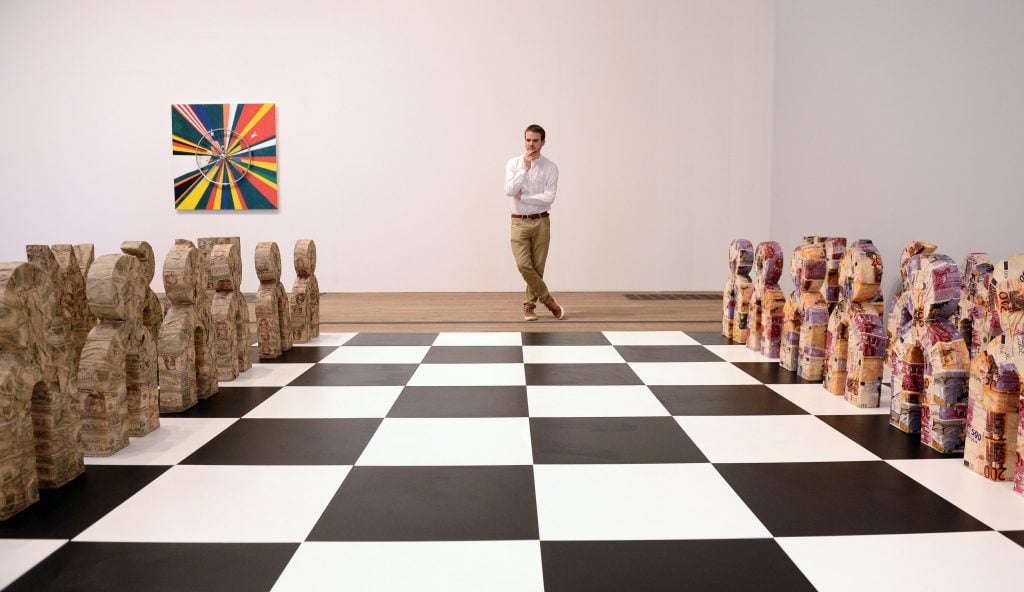
Meschac Gaba'southward chess gear up as part of the installation "Game Room" at Tate. Photo by Stefan Rousseau/PA Images via Getty Images.
Artwork inducements have become essential in an environment where donors are growing more reluctant to role with their cash. A recent report showed that more than than a third of Americans plan to give less to charitable causes in 2021 than they have in the by, or cease philanthropic giving entirely.
In the UK, a recent written report past the National Campaign for the Arts showed that institutions are increasingly reliant on individual donations amid a 35 percent drop in public arts funding since 2008 and a 39 percentage drop in corporate sponsorship since 2013. Meanwhile, philanthropic giving itself has fallen by 10 pct over the past three years.
All this is on top of the fact that public-facing institutions have recently been subject to more than serious scrutiny over the sources of their benefactors' wealth, causing some donors to pull back. Under pressure from activists, the Sackler Trust and the Dr. Mortimer and Theresa Sackler Foundation paused all philanthropic giving last year, while Warren Kanders, the president of a company that sells tear gas, was ousted from the Whitney's board of trustees . When the director of the Serpentine, Yana Peel, was pushed out final June, she warned that these types of campaigns "risk an erosion of individual support" for the art community.
Whether or not that turns out to exist an existential threat, erosion of individual support has intensified in lockdown. Swanky fundraising galas are (obviously) off the table, while many high-net-worth individuals are facing competing demands for their largesse from causes relating to the global health state of affairs.
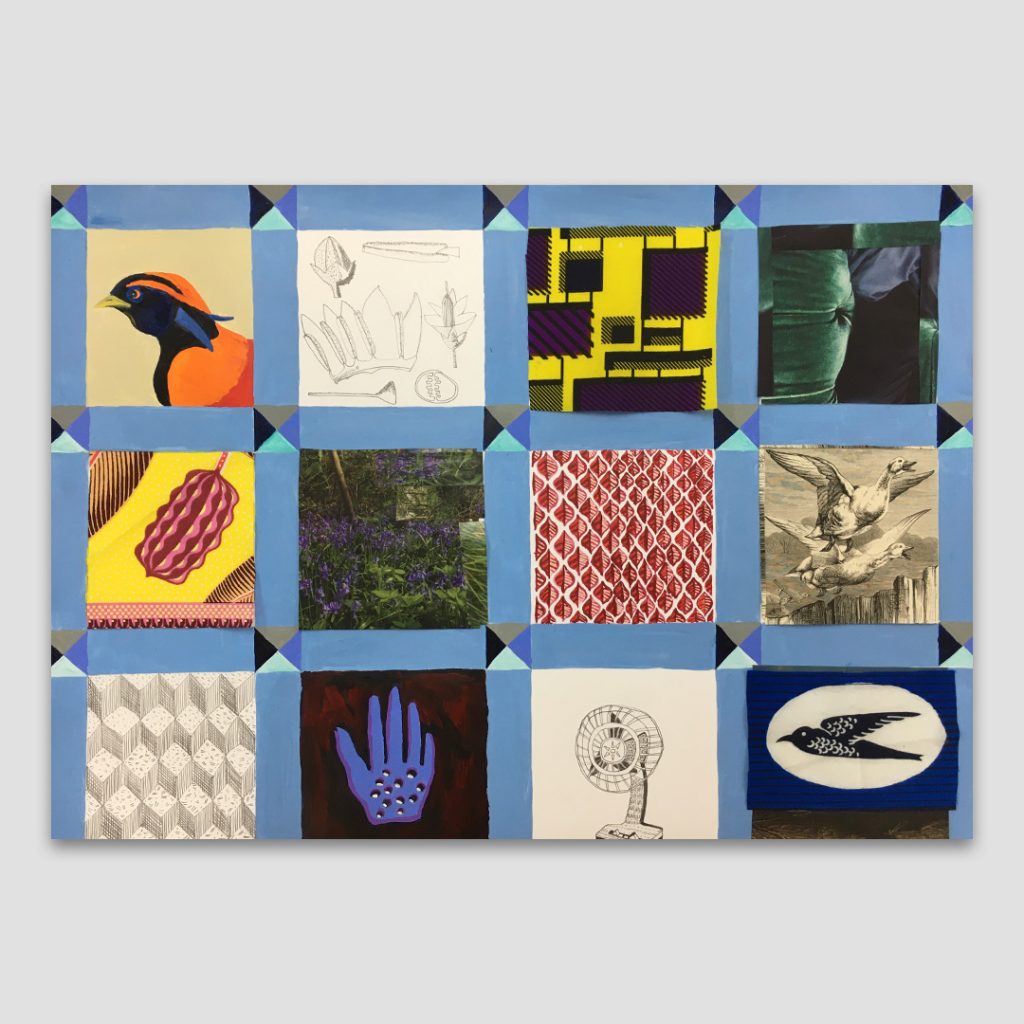
Lubaina Himid, The Coating of Reasonable Luxury (2020). Limited-edition signed impress, from a painting made particularly for the #TogetherForMuseums campaign. Courtesy Fine art Fund.
A Call to Artists
Information technology is against this backdrop that artists are being wheeled out to re-inspire and re-appoint wealthy patrons, as well as the general public, to donate. "Rewards, whether artist works or unique events, are a popular way to generate back up for [fundraising] campaigns, assuasive people to donate to an important crusade but get something bright back too," a spokesperson for the Great britain clemency Art Fund tells Artnet News.
The charity has launched its own fundraiser called Together for Museums , which is hoping to crowdfund £ane meg to help Uk art institutions through the current crisis. Incentives range from a set of David Shrigley tea towels (distributed to those who donate £fifteen) to a limited-edition print by Anish Kapoor (£4,000).
Using this arroyo, the charity managed to enhance over £three.8 million before this year to save the home and garden of visionary artist and filmmaker Derek Jarman. Nearly three quarters of the 8,397 donors to that project selected a reward. To date, its current fundraiser has attracted £336,071, with 82 days left in the entrada.
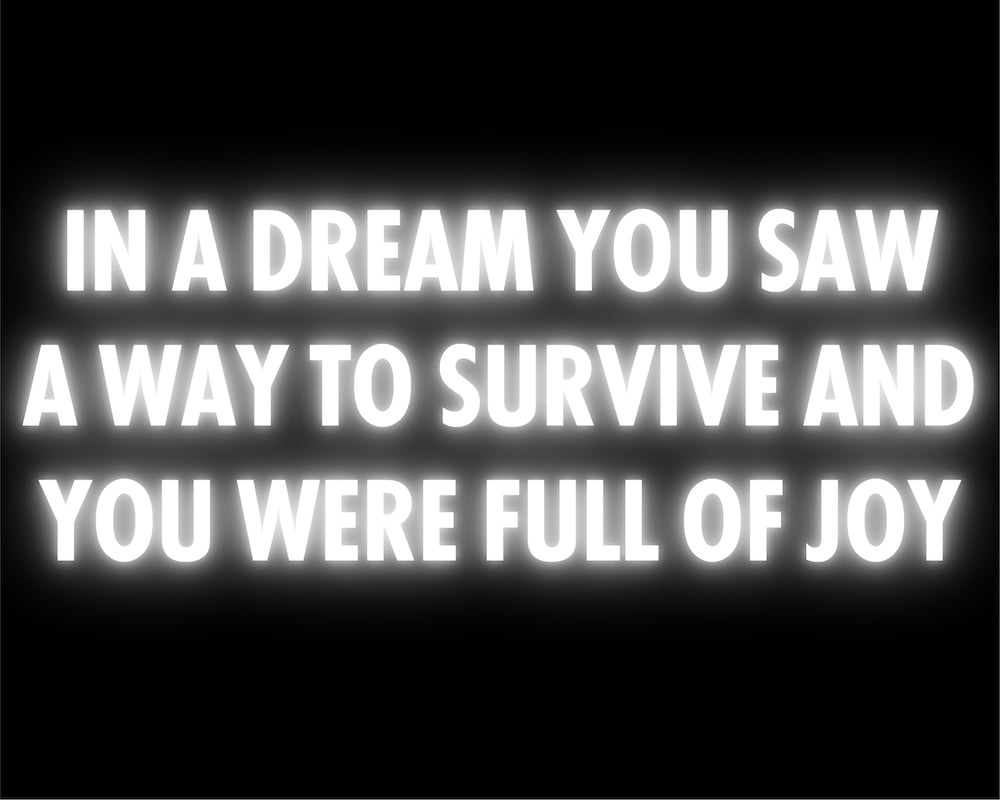
Jenny Holzer, from Survival 1983-85, (2020). © 2020 Jenny Holzer, member Artist Rights Society (ARS). Photograph: Graham Kelman.
The strategy is existence deployed at higher levels of the market as well. The mega-gallery Hauser & Wirth put together its own selling bear witness to raise coin for institutions in New York. More than 100 artists accept donated work to the Artists for New York initiative, with the proceeds dissever between 16 visual arts organizations and charitable nonprofits from the Studio Museum in Harlem to the Dia Art Foundation.
According to gallery co-president Marc Payot, the initiative, which launched in October and is still underway, has already raised millions of dollars. While "the customs engagement and philanthropic activity of our gallery's artists has always been quite robust," Payot tells Artnet News, the gallery has "certainly seen this action increase beyond the board" during lockdown.
Patrick Charpenel, the executive manager of El Museo del Barrio, 1 of the beneficiaries of the fundraiser, says that artist-driven initiatives have "complemented" the establishment'south ongoing efforts—especially of import for a museum that does not have the luxury of an endowment.
Similarly, London's Majestic University—which, unlike many UK institutions, does not receive funding from the government—has benefitted from artists' generosity. Some 100 artists created a special portfolio of new work to enhance money during the outset lockdown, and Grayson Perry has also designed a plate to incentivize donations of £i,000 or more. Many artists take also opted to donate more than the typical 30 percentage commission the RA takes from sales at its annual Summer Exhibition (held exceptionally, this twelvemonth, in the wintertime).
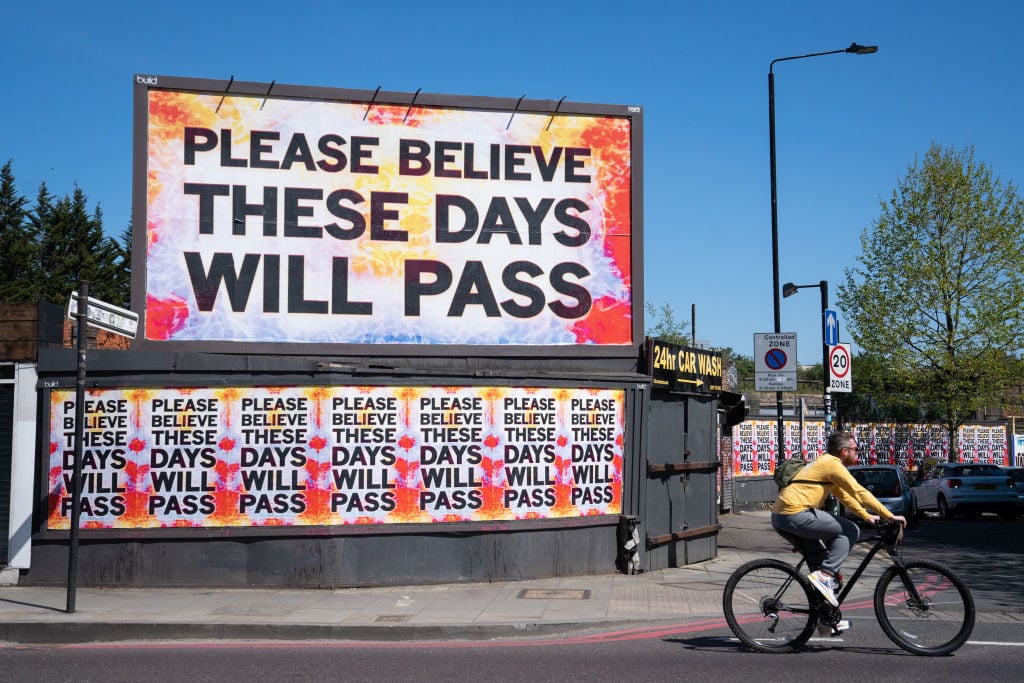
A cyclist rides past a billboard by the creative person Marking Titchner in Shoreditch, east London. Photo by Dominic Lipinski/PA Images via Getty Images.
A Heavy Burden
For artists who are already suffering income loss from postponed or cancelled exhibitions, this burden is not an piece of cake one to comport.
In donating a work to a charity sale, there is a chance that it may sell for below market place value or not sell at all, devaluing the artist'south market place. To boot, artists seldom savour the perks of a revenue enhancement deduction.
In the Britain, gifts of art to charity generally do not qualify for income taxation relief, so artists can't claim deductions for the total market value of their work. "HMRC'due south [the UK equivalent of the IRS] business organization is that if the artwork is overvalued, the donor would receive likewise much income tax relief," Amanda Greyness, a lawyer at Mishcon de Reya LLP, tells Artnet News.
While information technology is sometimes possible to merits a deduction on the fair market value of the donated artwork in the US, in that location are often strict weather condition attached, which Gray says by and large won't exist met if the donor is the artist or the art is sold at a charity auction.
In other words, if an artist donates a piece of work of art that would normally sell through their gallery for $l,000, they might only be able to deduct $500—the cost of materials—from their taxes. If a collector donated the same work, Gray says, the rules are "generally more relaxed."
Creating artwork is not the only way artists are boosting institutions, either. They too invest fourth dimension, inviting donors to studio visits to engage patrons.
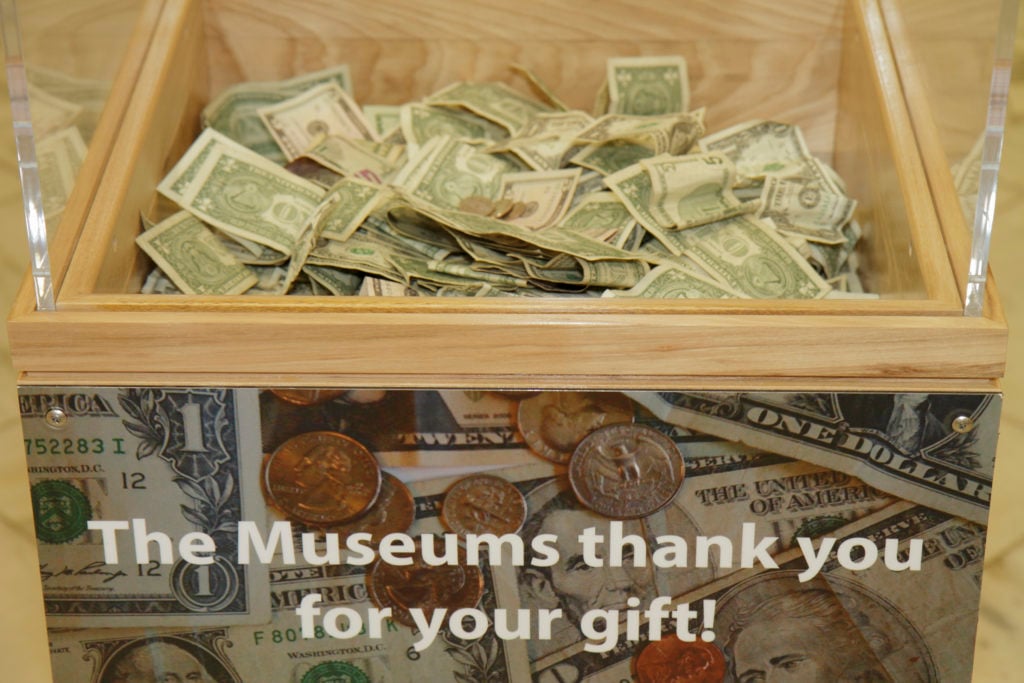
Donation box inside the National Portrait Gallery. Photo by: Jeffrey Greenberg/Universal Images Group via Getty Images.
Still, Rashid Johnson—who recently donated work to Artists for New York, auctioned off a studio visit at the Bronx Museum gala, and donated work to a Christie'south auction benefiting the Storm Rex Art Center—says he is happy to back up the important piece of work that institutions exercise inside the art ecosystem.
More often than not, Johnson says, he is even able to track his donation to come across which artists he was able to assistance—often, those who lack the fiscal backing of a gallery.
Museums seem to understand that relying on artists is not a perfect, or necessarily sustainable, solution. "I think that institutions recognize a lot of times that they would prefer a different strategy," Johnson notes, "only particularly smaller institutions accept limited options available to them."
Follow Artnet News on Facebook:
Want to stay ahead of the art globe? Subscribe to our newsletter to go the breaking news, eye-opening interviews, and incisive critical takes that drive the chat frontwards.
clarkbeentive1989.blogspot.com
Source: https://news.artnet.com/art-world/artist-museum-philanthropy-1930766
0 Response to "How an Artist Can Donate Their Art to a Museum"
Post a Comment