Is It Safe to Lift Baby by Arms

This is a partial list of weight training exercises organized by muscle groups.
Overview [edit]
The human trunk can exist broken down into different muscles and muscle groups, which tin be worked and strengthened by do. This table shows major muscles and the exercises used to piece of work and strengthen that musculus.
| Do | Calves | Quad- riceps | Ham- strings | Gluteus | Hips other | Lower back | Lats | Trapezius | Abdominals | Pectorals | Deltoids | Triceps | Biceps | Forearms |
|---|---|---|---|---|---|---|---|---|---|---|---|---|---|---|
| Squat | Some | Yes | Some | Aye | Yeah | Some | Yes | |||||||
| Leg press | Some | Yes | Some | Yes | ||||||||||
| Lunge | Yes | Yes | Yes | Yes | ||||||||||
| Deadlift | Some | Yes | Yes | Yes | Yes | Yes | Some | Some | Some | |||||
| Leg extension | Aye | |||||||||||||
| Leg curl | Some | Yes | ||||||||||||
| Standing calf heighten | Yes | |||||||||||||
| Seated dogie raise | Yes | |||||||||||||
| Hip adductor | Yes | |||||||||||||
| Bench press | Yes | Some | Yeah | |||||||||||
| Chest fly | Yes | Some | ||||||||||||
| Push-upwardly | Yes | Some | Yes | |||||||||||
| Pull-down | Yes | Some | Some | |||||||||||
| Pull-upward | Aye | Some | Some | Some | ||||||||||
| Bent-over row | Yes | Yes | Some | |||||||||||
| Upright row | Yes | Yes | Some | |||||||||||
| Shoulder printing | Some | Yes | Aye | |||||||||||
| Lateral raise | Some | Yes | ||||||||||||
| Shoulder shrug | Yes | Some | ||||||||||||
| Pushdown | Yes | |||||||||||||
| Triceps extension | Yes | Some | ||||||||||||
| Biceps curl | Yeah | Some | ||||||||||||
| Crunch | Yes | |||||||||||||
| Russian twist | Yes | |||||||||||||
| Leg raise | Yes | Some | ||||||||||||
| Back extension | Some | Yes | Yes | Yep |
Lower body [edit]
[1]
Quadriceps (front of thigh) [edit]
Squat [edit]

The squat is performed by squatting down with a weight held across the upper back (below the neck) and standing up direct over again. This is a chemical compound do that as well involves the glutes (buttocks) and, to a lesser extent, the hamstrings, calves, and the lower back. Lifting belts are sometimes used to help support the lower back. The freeweight squat is one of the three powerlifting competition exercises, along with the deadlift and the bench printing.[2]
- Equipment
- Squats can exist performed using just the practitioner's body weight. For weighted squats, a barbell is typically used, although the practitioner may instead hold dumbbells, kettlebells, or other weighted objects. Individuals uncomfortable performing freeweight squats may use a Smith machine or hack squat machine.
- Major variants
- Mutual variations include front end squats, in which the weight is held across the upper chest, and box squats, in which the practitioner rests briefly on a box or demote at the bottom of the movement.
Leg press [edit]
The leg press is performed while seated by pushing a weight away from the body with the anxiety. It is a chemical compound exercise that likewise involves the glutes and, to a lesser extent, the hamstrings and the calves. Overloading the machine tin result in serious injury if the sled moves uncontrollably towards the trainer.[three]
- Equipment
- Leg press machine.
Leg extension [edit]
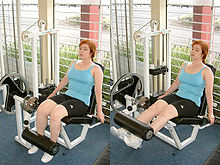
The leg extension is performed while seated by raising a weight out in front of the body with the anxiety. It is an isolation practise for the quadriceps. Overtraining can cause patellar tendinitis.[4] The legs extension serves to likewise strengthen the muscles effectually the knees and is an exercise that is preferred by physical therapists.
- Equipment
- Dumbbell, cablevision motorcar or leg extension machine.
Wall sit down [edit]
The wall sit, likewise known as a static squat, is performed past placing ane'south back against a wall with feet shoulder width apart, and lowering the hips until the knees and hips are both at right angles. The position is held equally long as possible. The exercise is used to strengthen the quadriceps. Contrary to previous communication in this section, this exercise is Not proficient for people with knee problems because the knees bear most of the load, especially when they are held at right angles (90 degrees).[ citation needed ]
- Equipment
- Body weight, wall or other apartment vertical surface, exercise ball placed behind the back is optional likewise.
Hamstrings (dorsum of thigh) [edit]
Deadlift [edit]

The deadlift is performed by lifting a weight off of the floor until fully upright. This is a chemical compound exercise that likewise involves the glutes, lower back, lats, trapezius (upper back), and, to a bottom extent, the quadriceps and the calves. Lifting belts are oftentimes used to help support the lower dorsum. If performed with a barbell, information technology can be held with both hands facing backwards or with one mitt facing backward and one facing forward. Both hands should non face frontwards because this puts excess stress on the inner elbows.
- Equipment
- Dumbbells, barbell, trapbar or Smith auto.
- Major variants
- Sumo (wider opinion to emphasise the inner thighs); strong legged (emphasizes hamstrings); straight-legged (emphasizes lower back).
Stiff-legged deadlift [edit]
The stiff-legged deadlift is a deadlift variation where little to no knee movement occurs, increasing hamstring, glute, and lower back activation. The bar starts on the flooring and the individual sets up like a normal deadlift but the knees are at a 160° angle instead of 135° on the conventional deadlift.
Leg whorl [edit]
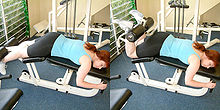
The leg gyre is performed while lying face down on a bench, by raising a weight with the anxiety towards the buttocks. This is an isolation exercise for the hamstrings.[v]
- Equipment
- Dumbbell, cable machine or leg whorl automobile.
- Major variants
- Seated (using a leg curl machine variant); standing (1 leg at a time).
Snatch [edit]
The snatch is one of the 2 current olympic weightlifting events (the other being the clean and jerk). The essence of the event is to elevator a barbell from the platform to locked arms overhead in a smooth continuous movement. The barbell is pulled as high as the lifter tin manage (typically to mid [ breast] height) (the pull) at which signal the barbell is flipped overhead. With relatively light weights (as in the "ability snatch") locking of the artillery may not crave rebending the knees. However, every bit performed in contests, the weight is always heavy enough to demand that the lifter receive the bar in a squatting position, while at the same fourth dimension flipping the weight so information technology moves in an arc directly overhead to locked artillery. When the lifter is secure in this position, he rises (overhead squat), completing the lift.
Calves [edit]
Continuing dogie heighten [edit]
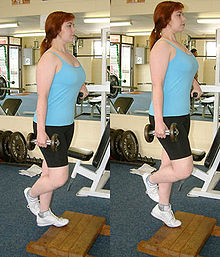
Dumbbell single-leg standing calf raise
The standing calf raise is performed past plantarflexing the feet to lift the body. If a weight is used, and so it rests upon the shoulders, or is held in the hand(southward). This is an isolation practise for the calves; information technology especially emphasises the gastrocnemius muscle, and recruits the soleus muscle.[6]
- Equipment
- Body weight, dumbbells, smartbells, doorbells, cowbells, bong peppers, barbell, Smith auto or standing dogie enhance automobile.
- Major variants
- One leg (the other is held off the ground); donkey dogie raise (bent over with a weight or motorcar pad on the lower dorsum).
Seated calf raise [edit]
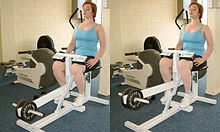
Seated calf raise machine
The seated calf raise is performed by flexing the anxiety to lift a weight held on the knees. This is an isolation exercise for the calves, and particularly emphasises the soleus musculus.[vii]
- Equipment
- Barbell or seated calf enhance machine; can as well be done on a leg press machine.
Pelvis [edit]
- Vaginal weightlifting refers to strength training using the contraction of the pelvic floor muscles to lift weights after inserting an zipper in the vagina.
Upper trunk [edit]
Pectorals (chest) [edit]
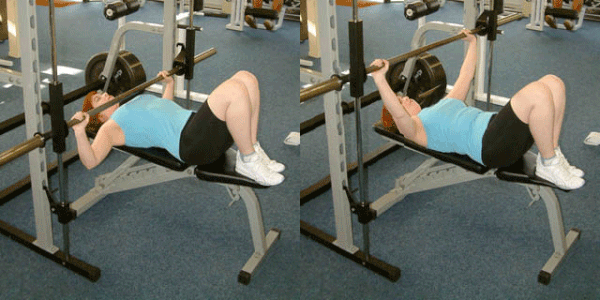
Smith automobile bench press
- The demote press or dumbbell demote-press is performed while lying face upwardly on a bench, by pushing a weight away from the chest. This is a compound practice that also involves the triceps and the front end deltoids, besides recruits the upper and lower back muscles, and traps. The bench press is the rex of all upper body exercises and is one of the near pop chest exercises in the world. Information technology is the final exercise in 'The large 3'.
- Equipment: dumbbells, barbell, Smith automobile or demote press machine.
- Major variants: incline ~ (more emphasis on the upper pectorals), decline ~ (more emphasis on the lower pectorals), narrow grip ~ (more emphasis on the triceps), push-up (face downwards using the body weight), neck printing (with the bar over the neck, to isolate the pectorals), vertical dips (using parallel dip confined) or horizontal dips (using two benches with arms on the near demote and feet on the far bench, and dropping the buttocks to the floor and pushing back upwards.)
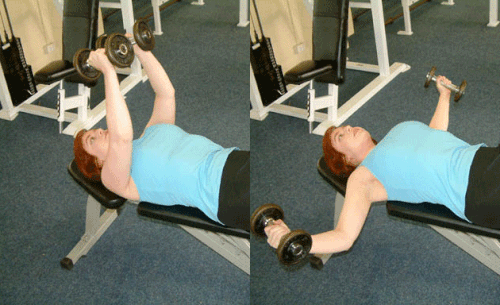
- The chest fly is performed while lying face upwards on a bench or continuing up, with arms outspread belongings weights, by bringing the arms together in a higher place the breast. This is a chemical compound practise for the pectorals. Other muscles worked include deltoids, triceps, and forearms.
- Equipment: dumbbells, cable machine or "pec deck" machine.
- Major variants: incline ~ (more than emphasis on the upper pectorals), reject ~ (more than emphasis on the lower pectorals), cable crossover.
- Cable crossovers
- Dips
Lats (mid back) [edit]

- The pulldown is performed while seated by pulling a wide bar downwardly towards the upper chest or behind the neck. This is a compound exercise that also involves the biceps, forearms, and the rear deltoids.
- Equipment: cable machine or pulldown machine.
- Major variants: mentum-up or pullup (using the torso weight while hanging from a loftier bar), shut grip ~ (more accent on the lower lats), reverse grip ~ (more than emphasis on the biceps).
- The Pull-up is performed by hanging from a chin-up bar above head height with the palms facing forward (supinated) and pulling the body up so the chin reaches or passes the bar. The pull-up is a compound exercise that besides involves the biceps, forearms, traps, and the rear deltoids. A mentum-up (palms facing backwards) places more than accent on the biceps and a broad grip pullup places more emphasis on the lats. Equally beginners of this exercise are often unable to elevator their own bodyweight, a chin-up car can be used with counterweights to assist them in the lift.
- Equipment: chin-up bar or chin-up motorcar.

- The bent-over row is performed while leaning over, holding a weight hanging downwards in i hand or both hands, by pulling it upward towards the abdomen. This is a compound exercise that also involves the biceps, forearms, traps, and the rear deltoids. The torso is unsupported in some variants of this do, in which case lifting belts are often used to help support the lower back.
- Equipment: dumbbell, barbell, Smith machine or T-bar auto.
- Major variants: cable row (using a cablevision motorcar while seated).
Deltoids (shoulders) [edit]

Cablevision machine upright row
- The upright row is performed while standing, holding a weight hanging downward in the hands, past lifting it straight up to the collarbone. This is a compound practice that also involves the trapezius, upper dorsum, forearms, triceps, and the biceps. The narrower the grip the more the trapezius muscles are exercised.
- Upright rows are prone to injure the shoulder through internal rotation and elevation of the brawl and socket joint.
- Equipment: dumbbells, barbell, Smith auto or cable machine.

- The shoulder printing is performed while seated, or standing by lowering a weight held in a higher place the head to simply above the shoulders, and so raising it again. It tin be performed with both artillery, or one arm at a time. This is a compound do that also involves the trapezius and the triceps.
- Major variants: 360 Degree Shoulder Printing (wrists are rotated while weights are lifted, and then weights are lowered in front of the head before beingness rotated back to the get-go position).
- The military machine printing is like to the shoulder press but is performed while continuing with the feet together. (It is named "war machine" considering of the similarity in appearance to the "at attention" position used in nigh militaries) Unlike the seated shoulder press, the military press involves the majority of the muscles of the core every bit stabilizers to continue the body rigid and upright, and is thus a more constructive compound exercise.
- Equipment: dumbbells, kettlebells, barbell, Smith automobile or shoulder printing machine.
- Major variants: Arnold Press (dumbbells are raised while rotating the palms outwards).

- The lateral raise (or shoulder fly) is performed while standing or seated, with easily hanging downward holding weights, by lifting them out to the sides until merely below the level of the shoulders. A slight variation in the lifts can striking the deltoids even harder, while moving upwards, simply turn the hands slightly downward, keeping the terminal finger higher than the thumb. This is an isolation practice for the deltoids. Too works the forearms and traps.
- Equipment: dumbbells, cable machine or lateral enhance machine.
- Major variants: front heighten (lift weights out to the front; emphasis is on the front deltoids), aptitude-over ~ (accent is on the rear deltoids), 180 degree lateral raise (weights are held slightly in forepart of the body and lifted over the head in a circular motion).
Triceps (back of artillery) [edit]

- The pushdown is performed while continuing by pushing down on a bar held at the level of the upper chest. It is important to continue the elbows at shoulder width and in line with shoulder/legs. In other words, elbows position should not change while moving the forearm pushes downwardly the bar. This is an isolation exercise for the triceps.
- Equipment: cable machine or pulldown car.

Lying dumbbell triceps extension demonstrating no arching of dorsum at elevation of movement
- The triceps extension is performed while standing or seated, by lowering a weight held to a higher place the caput (keeping the upper arms motionless), and and so raising it again. It can exist performed with both arms, or ane arm at a time. This is an isolation practice for the triceps. It is as well known every bit the french ringlet.
- Equipment: dumbbell(s), barbell, cable machine or triceps extension machine.
- Major variants: lying ~ (lying face upwardly with the weights over the face), kickback (bent over with the upper arm parallel to the body).
Biceps (front of arms) [edit]

Dumbbell biceps curl on the preacher bench using momentum of body to assistance lift weights
- The Preacher curl is performed while standing or seated, with easily hanging down property weights (palms facing forwards), past crimper them up to the shoulders. It can be performed with both arms, or one arm at a fourth dimension.
- Continuing barbell coil
- Alternating rotating dumbbell roll
- Hammer scroll
- The Zottmann curl gives a stronger focus to forearm training compared to the traditional curlicue.
Waist [edit]
Abdominals [edit]
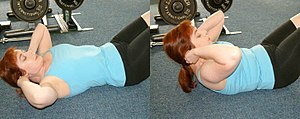
- The crunch is performed while lying confront on the floor with knees aptitude, by curling the shoulders up towards the pelvis. This is an isolation exercise for the abdominals.
- Equipment: body weight, dumbbell or crunch motorcar.
- Major variants: reverse ~ (curling the pelvis towards the shoulders), twisting ~ or side ~ (lifting one shoulder at a time; emphasis is on the obliques), cable ~ (pulling down on a cable machine while kneeling), sit down-up ~ (take [breast] touch your knees), vertical crunch (propping upwardly to dangle legs and pulling knees to the [ chest] or keeping legs straight and pulling up legs to a xc degree position). Opposite hanging crisis (using gravity boots or slings to hang head downward and pulling to a 90 or 180 degree form)

- The leg raise is performed while sitting on a bench or flat on the floor by raising the knees towards the shoulders, or legs to a vertical upright position. This is a compound practise that also involves the hip flexors.
- Equipment: body weight or dumbbell.
- Major variants: hanging ~ (hanging from a high bar), side ~ (lying on side), knee raise (lying on dorsum, drawing knees to chest).
- The Russian twist is a type of exercise that is used to work the belly muscles by performing a twisting move on the abdomen. This practise is performed sitting on the floor with knees bent like in a "sit down-up" position with the back typically kept off the floor at an angle of 45°. In this position, the extended arms are swung from one side to some other in a twisting motion with or without weight.
- Equipment: torso weight, kettlebell, medicine ball, or dumbbell.
- Major variants: back kept off the floor at 45° angle, back rested on exercise brawl, feet resting on the floor, anchored or kept off the floor.
Lower back [edit]
Back extension [edit]

Back extension on a Roman chair
The back extension is performed while lying face down partway along a apartment or angled bench, so that the hips are supported and the heels secured, by bending down at the waist then straightening up again. This is a compound exercise that also involves the glutes.
- Equipment
- Body weight, dumbbell or back extension machine.
- Major variants
- Without bench (lying face downwardly on the floor).
Deadlift [edit]
The deadlift is a very effective compound exercise for strengthening the lower back, but also exercises many other major muscle groups, including quads, hamstrings and abdominals. Information technology is a challenging practice, as poor course or execution can crusade serious injury.[viii] A deadlift is performed by grasping a dead weight on the floor and, while keeping the back very straight, standing up by contracting the erector spinae (main lower dorsum musculus). When performed correctly, the office of the arms in the deadlift is merely that of cables attaching the weight to the body; the musculature of the arms should not exist used to lift the weight. There is no movement more basic to everyday life than picking a dead weight up off of the floor, and for this reason focusing on improving one's deadlift will aid foreclose back injuries.
Incorrect technique and forrard lean posture with a flexed spine tin can leed to discal injuries of the lower back. Correct technical performance with a slightly hollow or extended back and a hip swivel to keep the normal curvature of the spine is of utmoste importance.
Good-morning [edit]
The good-morning is a weight training exercise in which a barbell, 2 dumbbells, or no weight at all is held on the shoulders, behind the head. The person bends forward and bows at the hips and recovers to upright. The good-morning is so called because the movement resembles bowing to greet someone. Information technology involves the hamstrings but is primarily used to strengthen the lower back; the degree of knee joint bend used will modify the focus – nearly directly-legged involving the hamstrings near.
Wrong technique and forward lean posture with a flexed spine tin leed to discal injuries of the lower back. Correct technical functioning with a slightly hollow or extended back to proceed the normal curvature of the spine is of utmost importance.
References [edit]
- ^ Johnson-Cane, Deidre; Cane, Jonathan; Glickman, Joe (2000). The Complete Idiot'south Guide to Weight Training . Indianapolis: Alpha Books. pp. 169. ISBN978-0-7865-4251-2.
- ^ Johnson-Cane et al., p. 170
- ^ Johnson-Cane et al., p. 173.
- ^ Johnson-Cane et al., p. 175.
- ^ Johnson-Cane et al., p. 177.
- ^ Johnson-Cane et al., p. 179.
- ^ Johnson-Cane et al., p. 180.
- ^ Johnson-Pikestaff et al., p. 187
External links [edit]
- ExRx.net – listing of exercises by muscle group
clarkbeentive1989.blogspot.com
Source: https://en.wikipedia.org/wiki/List_of_weight_training_exercises
0 Response to "Is It Safe to Lift Baby by Arms"
Post a Comment