Drawing of Head of Old Woman and Also Be Read as the Head of Young Woman
| La Scapigliata | |
|---|---|
| English: The Lady with Dishevelled Hair | |
 | |
| Artist | Leonardo da Vinci |
| Yr | c. 1506–1508 (unfinished) |
| Medium | Oil, umber, and white atomic number 82 pigments on poplar forest console |
| Dimensions | 24.vii cm × 21 cm (9.vii in × viii.three in) |
| Location | Galleria Nazionale, Parma |
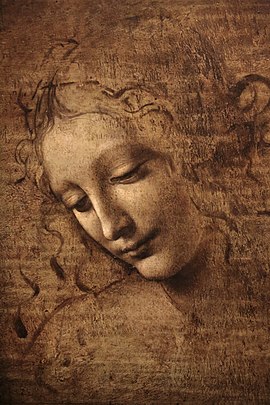
La Scapigliata [n one] (Italian for 'The Lady with Dishevelled Pilus') is an unfinished painting generally attributed to the Italian High Renaissance artist Leonardo da Vinci, and dated c. 1506–1508. Painted in oil, umber, and white lead pigments on a minor poplar woods panel, its attribution remains controversial, with several experts attributing the work to a pupil of Leonardo. The painting has been admired for its captivating beauty, mysterious demeanor, and mastery of sfumato.
There is no real consensus on the field of study, engagement, history, or purpose of the painting. It shows an unidentified woman gazing downwards while her hair fills the frame behind her. Many theories regarding the subject have been proposed: that it is a sketch for an uncompleted painting of Saint Anne; a study for the London version of the Virgin of the Rocks or Leonardo's lost painting of Leda and the Swan; or a painting left deliberately unfinished for its aesthetic value.
The painting was recorded in the sale in 1826 of Gaetano Callani's collection to the Galleria Nazionale di Parma, the museum in which it is currently housed, but proof of its existence may engagement back to 1531, when it may have been possessed by Isabella d'Este. Although many studies of Leonardo'due south oeuvre are silent on the issue, most scholars who talk over the painting regard it as an autographic work past Leonardo da Vinci and information technology has been listed every bit such in various major Leonardo exhibitions.
Name [edit]
The painting has no formal proper name but is best known past the nickname La Scapigliata [n 1] (English: The Lady with Dishevelled Pilus),[2] in reference to the tousled and waving hair of the subject.[3] It has been known past various other names in combination with La Scapigliata, including Head of a Adult female,[four] Caput of a Immature Woman,[5] Head of a Immature Girl,[6] Head and Shoulders of a Woman,[7] Portrait of a Maiden,[viii] and Female Caput.[9]
Description [edit]
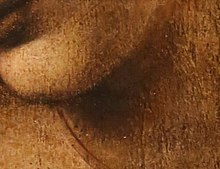
Particular of sfumato in La Scapigliata
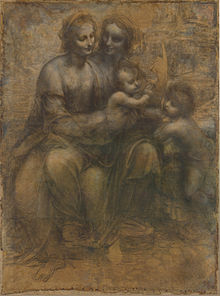
The true intention for the work's cosmos is unknown, and it has been variously referred to as a sketch, a drawing, or a painting.[10] Due to the use of paint, it is correctly described equally a painting,[one] but scholars continue to discuss its sketch- and drawing-like qualities, oftentimes linking it to Leonardo's early works such as the Admiration of the Magi and Saint Jerome in the Wilderness,[7] as well equally later ones such every bit The Virgin and Child with Saint Anne and Saint John the Baptist.[11] The art historian Carmen Bambach suggests that it should be described as a "brush cartoon", or as a "painted sketch".[5]
The painting is executed on a small-scale [north 2] 24.6 cm × 21.0 cm (9.seven in × 8.3 in) poplar wood panel with oil, umber, and white pb pigments.[xiii] It portrays the unfinished outline of a young woman whose face gently gazes downward while her loosely drawn, dishevelled pilus waves in the air behind her.[7] The woman's eyes are half-closed and completely ignore the exterior world and viewer, while her rima oris is slightly shaped into an ambiguous smile, evocative of the Mona Lisa.[3] Other than her face that takes up well-nigh of the painting, the rest of the painting is barely even sketched in, with a primed, simply unpainted, background.[4] The differences in the face up and the balance of the painting are effectively composite by a mastery of sfumato.[3] The art historian Alexander Nagel notes that the sfumato results in the shadows concealing any strokes or marks, and points out how the shadows are softened by careful lighting around them, such every bit on the left side of the jaw.[14] The appeal in this contrast of the unfinished and finished parts has provoked speculation that the painting is non incomplete, but was left in a sketchy land on purpose.[7] [x]
The subject of the painting is unknown and no theory has proved convincing enough for modern scholars to reach a consensus about it.[i] One theory is that the work is a written report for Leonardo's lost painting of Leda and the Swan, merely this is discredited by existing copies of the painting showing Leda with pilus more elaborate than that of the woman in La Scapigliata. [seven] It is besides claimed that the painting was a sketch for a painting of Saint Anne that never was completed, or a study for the London version of the Virgin of the Rocks.[one] According to scholars at the Galleria Nazionale di Parma, the subject field of the painting may be a portrait of an anonymous woman.[iii]
Attribution [edit]
It is generally agreed by mod scholars that La Scapigliata is by Leonardo da Vinci.[15] The attribution is not so widely accepted equally other debated Leonardo paintings, such as his Ginevra de' Benci, Portrait of a Musician, Lady with an Ermine, and Saint John the Baptist and is ignored by some art historians, with many refraining from even commenting on it.[12] [16] The art historians Martin Kemp and Frank Zöllner omit the work from their catalogues of Leonardo's paintings,[17] while Luke Syson proposes that it is the work of one of Leonardo'southward many pupils.[eighteen]
Doubts concerning the attribution of the painting are not contempo. In 1896 Corrado Ricci, director of the Galleria Nazionale, claimed that information technology had been forged by its former owner, Gaetano Callani,[1] [10] which caused it to exist re-attributed as "past the school of Leonardo".[10] In 1924 this claim was challenged by the art historian Adolfo Venturi, who asserted that it was by Leonardo, and who revealed evidence that sought to link the piece of work with the House of Gonzaga.[one] The attribution to Leonardo was further advocated by Carlo Pedretti, who connected the painting to Isabella d'Este, a known patron of Leonardo.[ane] [11] Most scholars take since accepted the work to exist an autographic Leonardo,[19] but modern critics such as the fine art historian Jacques Franck continue to question its actuality.[4] [20] Franck, basing his doubts on the irregular proportions and strangely shaped skull of the discipline, has proposed the painting to exist by Leonardo'due south pupil Giovanni Boltraffio. He has cited the similarity between La Scapigliata and Boltraffio's piece of work Heads of the Virgin and Child.[xx] Bernardino Luini, another pupil of Leonardo, has likewise been suggested equally the artist, the evidence being based on his depictions of female faces.[1]
Major exhibitions at the Louvre (2003), Milan (2014–2015), New York (2016), Paris (2016), Naples (2018), and again at the Louvre (2019–2020), accept all displayed the painting as existence by Leonardo.[21]
Dating [edit]
The painted is usually dated c. 1506–1508 based on stylistic similarities to other works by Leonardo, namely the Virgin and Child with Saint Anne and Saint John the Baptist and the London Virgin of the Rocks.[22] [23] [24] In 2016, Bambach dated the painting to c. 1500–1505, since she believes that Leonardo was commissioned by Agostino Vespucci at this time.[7]
History [edit]
No records of a commission survive for the painting, simply its intimacy suggests that it may have been for a individual patron.[vii] Bambach cites a note by the Florentine official Agostino Vespucci that mentions Leonardo, and describes the appeal and dazzler of the unfinished bosom of Venus by the famous ancient Greek painter Apelles.[7] She believes that La Scapigliata may be the result of Vespucci commissioning Leonardo to execute a work forth the same lines.[25]

Portrait of Isabella d'Este past Leonardo da Vinci (1499–1500) depicts the Marchioness of Mantua, the proposed patron of La Scapigliata
A more widely accepted theory is that the work was deputed by a known patron of Leonardo and a member of the Gonzaga family of Mantua, Isabella d'Este. She was 1 of the leading women of the Italian Renaissance, a major cultural and political figure, who had asked Leonardo for a painting of the Madonna for her private studio in 1501.[21] Isabella d'Este probably gave the painting to her son Federico Two on the occasion of his hymeneals to Margaret Paleologa.[26] This is evidenced by a 1531 letter from the secretary of the Mantuan Gonzaga family, Ippolito Calandra, who suggests that a painting (with very similar features as La Scapigliata) be hung in the chamber of Federico 2 and Margaret Paleologa.[eleven] A 1531 inventory of the Gonzaga family fine art collection in the ducal palace also records a painting that could be La Scapigliata.[15] Some other inventory from 1627 likely refers to La Scapigliata and is likely to be the origin of the nickname for the painting since the record describes it every bit follows: "A painting depicts the head of a dishevelled adult female... by Leonardo da Vinci."[10] [xv] This record implies that information technology was not sold amidst a large sale of paintings from the Gonzaga collection to Charles I of England in 1626–1627. Information technology is possible that the painting was stolen from the Gonzaga collection in July 1630 when, nether the pay of Ferdinand 2, an purple army of 36,000 Landsknecht mercenaries sacked Mantua.[21]
The adjacent (and first certain) record of the painting is in 1826, when Francesco Callani offered the collection of his male parent, the Parmesan artist Gaetano Callani, for sale to the gallery of the Accademia di Belle Arti di Parma.[x] [xv] In a list of the works in the drove for the gallery's director, Paolo Toschi, La Scapigliata appears listed as "A head of Madonna painted in chiaroscuro".[1] The sale implies that it entered the collection of Gaetano Callani at some point, probably during his 1773–1778 stay in Milan, merely other than beingness in Milan, in that location is no information on the whereabouts of the painting prior to that notation.[x] [21] The sale took place in 1839, but the painting identified equally La Scapigliata entered the gallery of Palatine Gallery of Parma (now the Galleria Nazionale di Parma), where information technology was listed as "The head of Leonardo da Vinci" and described by Toschi as "a very rare work to find today".[3] [10] It has been housed in the National Gallery of Parma ever since.[15]
Interpretation [edit]
"Here Leonardo does not only create an icon of female dazzler merely much more. With a unique experimentalism of its kind, information technology manages to summarize the divine complexity of reality."
Pietro C. Marani[21]
Many theories have been proposed nigh the intended purpose and meaning of the work, which the Galleria Nazionale di Parma suggests is due to the ambiguity in the work's 'painted-drawing' demeanor.[three] Scholars at the Metropolitan Museum of Art note that the dissimilarity betwixt the subject field's sculptural and detailed face up with her fragmentary hair, shoulders, and neck evokes a similar contrast between intensity and freedom.[7] Scholars at the Galleria Nazionale take interpreted this dissimilarity as a feminist representation of powerful, merely elegant, femininity.[21]
The work has been recognized as the apex of Leonardesque sfumato.[24] Nagel notes the attentive detail to masterful shadowing and lighting.[14] Nagel compares La Scapigliata with head studies by Leonardo's teacher, Andrea del Verrocchio, noting the similar arroyo and attending given to the shading,[14] and that both Verrocchio's studies of female heads and Leonardo's La Scapigliata seem to 'know' that the border of the panel exists. He concludes that,
"In Leonardo's work, shadow is investigated to the signal where it assumes an entirely new function, Shadows no longer "belong" to the form but are treated as variations of a more than general visual phenomenon, field of study to the laws that govern all visibility. They conduct equally gradual modulations within a continuous range extending between 'the beginnings and the ends of shadow,' that is, from lite to absolute darkness. The shadow against the right cheek ('outside the form') belongs to the same system as the shadows nether the mentum, on the cheek, or around the eyes; under unlike atmospheric condition, they might unite to swallow the entire face."[14]
It is uncertain what access Leonardo would accept had to Pliny the Elderberry'due south Natural History, but in 2016 Bambach speculates that La Scapigliata may have been inspired by an chestnut from it. Pliny refers to an unfinished painting of Venus of Cos by the famous ancient Greek painter Apelles that was admired fifty-fifty though it was unfinished. Bambach cites a notation from Agostino Vespucci that mentions both Leonardo and this story, and claims that Leonardo was inspired to achieve the same result every bit Apelles.[25]
Notes [edit]
- ^ a b pronounced [la ska.pi.ʎi.ˈa.ta]; sometimes spelled Scapiliata;[1] known past various names.
- ^ Out of all paintings attributed to Leonardo, La Scapigliata is the smallest[12]
References [edit]
- ^ a b c d east f chiliad h i Galleria Nazionale di Parma – New Website.
- ^ Reynolds 1962, p. 703.
- ^ a b c d e f Galleria Nazionale di Parma – Onetime Website.
- ^ a b c Palmer 2018, p. 70.
- ^ a b Bambach 2003, p. 97.
- ^ Marani 2003, p. 145.
- ^ a b c d e f g h i Baum et al 2016, p. 297.
- ^ Pedretti 2006, p. 70.
- ^ Fried 2010, p. 74.
- ^ a b c d due east f k h Marino 2018.
- ^ a b c Vezzosi 2019, p. 275.
- ^ a b Marani 2019, pp. 338–340.
- ^ Metropolitan Museum of Fine art.
- ^ a b c d Nagel 1993, p. 11.
- ^ a b c d e Marani 2003, p. 340.
- ^ Boussel 1989, p. 87.
- ^ Zöllner 2019, pp. 212–251.
- ^ Syson et al 2011, p. 198.
- ^ Marani 2019, p. 340.
- ^ a b Manca 2020.
- ^ a b c d e f La fortuna della Scapiliata di Leonardo da Vinci.
- ^ Marani 2003, p. 145, 340.
- ^ Vezzosi 2019, p. 58.
- ^ a b Fried 2010, p. seventy.
- ^ a b Baum et al 2016, p. 37.
- ^ Marani 2019, p. 423.
Sources [edit]
- Books
- Bambach, Carmen C., ed. (2003). Leonardo da Vinci, Master Draftsman. New York City, New York: Metropolitan Museum of Art. ISBN978-0-300-09878-five.
- Baum, Kelly; Bayer, Andrea; Wagstaff, Sheena (2016). Unfinished: Thoughts Left Visible. New York City, New York: Metropolitan Museum of Art. ISBN978-one-58839-586-iii.
- Boussel, Patrice (1989). Leonardo da Vinci. Chartwell House. ISBN978-i-55521-103-5.
- Fried, Michael (2010). The Moment of Caravaggio . Princeton, New Jersey: Princeton University Press. ISBN978-0-691-14701-vii.
- Marani, Pietro C. (2003) [2000]. Leonardo da Vinci: The Complete Paintings. New York City, New York: Harry North. Abrams. ISBN978-0-8109-3581-5.
- Marani, Pietro C. (2019). "Tête de jeune femme". In Delieuvin, Vincent; Frank, Louis (eds.). Léonard de Vinci (in French). Louvre, Paris: Hazan. pp. 423–424. ISBN978-2-7541-1123-2.
- Palmer, Allison Lee (2018). Leonardo da Vinci: A Reference Guide to His Life and Works (Significant Figures in World History). Lanham, Maryland: Rowman & Littlefield. ISBN978-1-5381-1977-8.
- Pedretti, Carlo (2006). Leonardo: Art and Science. Surrey, England: Taj Books International. ISBN978-1-84406-036-viii.
- Reynolds, Barbara, ed. (1962). The Cambridge Italian Dictionary. Cambridge University Printing. ISBN9780521087087. OCLC 312852991.
scapigliato - dishevelled, ruffled, rumpled
- Syson, Luke; Keith, Larry; Galansino, Arturo; Mazzotta, Antoni; Nethersole, Scott; Rumberg, Per (2011). Leonardo da Vinci: Painter at the Courtroom of Milan (1st ed.). London, England: National Gallery. ISBN978-1-85709-491-6.
- Vezzosi, Alessandro (2019). Léonard de Vinci: Tout l'œuvre peint, un nouveau regard (in French). Translated by Temperini, Renaud. Paris: Martiniere BL. ISBN978-2-7324-9087-viii.
- Zöllner, Frank (2019) [2003]. Leonardo da Vinci: The Complete Paintings and Drawings (Anniversary ed.). Cologne, Germany: Taschen. ISBN978-3-8365-7625-3.
- Articles
- Nagel, Alexander (1993). "Leonardo and sfumato". Res: Anthropology and Aesthetics. 24 (24): 7–20. doi:ten.1086/RESv24n1ms20166875. JSTOR 20166875. S2CID 193557811.
- Online
- "Head of a Woman (La Scapigliata)". New York City, New York: Metropolitan Museum of Fine art. Archived from the original on xvi January 2020.
- "La fortuna della Scapiliata di Leonardo da Vinci" (in Italian). Parma, Italy: Galleria Nazionale di Parma. Archived from the original on 24 May 2020.
- "La Scapigliata" (in Italian). Parma, Italy: Galleria Nazionale di Parma. Archived from the original on nineteen April 2014.
- Marino, Carlo (20 Baronial 2018). "Leonardo's The Head of a Adult female in Naples". European News Agency. Archived from the original on 15 February 2021.
- Manca, Isabelle (January 2020). "Un expert réfute l'attribution de La Scapigliata à Léonard" (in French). Le Journal des Arts. Archived from the original on 19 February 2020.
- "Testa di fanciulla, detta "La scapiliata"" (in Italian). Parma, Italy: Galleria Nazionale di Parma. Archived from the original on seven July 2020.
External links [edit]
- La Scapigliata, Galleria Nazionale di Parma
- La Scapigliata, Metropolitan Museum of Art
clarkbeentive1989.blogspot.com
Source: https://en.wikipedia.org/wiki/La_Scapigliata
0 Response to "Drawing of Head of Old Woman and Also Be Read as the Head of Young Woman"
Post a Comment